What does BDSM have to do with Shame Healing?

Updated: 16 minutes ago

Shame tells us there is something fundamentally wrong with us. It says that on some level
we’re broken, flawed, bad, or even sinful.
Shame says we are not good. And because we’re not good, we are not lovable and therefore at risk of being judged, scrutinized, or ostracized from the various communities we rely on for social connection, resources, and safety.
Shame tells us to hide parts of ourselves. To wear masks to fit in, and to play the select few songs and dances of social behavior that have been collectively deemed as “okay,” “good,” and “worthy.”
This is all the same when it comes to our sexualities.
So many of us have shame around our sexuality and desires. So much so that we never take action towards exploring them. Or if we do, the backdrop of that exploration is tainted with conscious (or unconscious) questioning of “Am I doing this right?” “Is this okay?” “Am I still good? Am I still worthy of love?”
More people than you think carry secret desires around submission.
They long for someone else to be in control both in and out of the bedroom. To release the burden of decision, to be told what to do, and to be used for someone else’s pleasure. And many are deeply ashamed of this, as these desires contradict the identity they’ve spent a lifetime creating—being the one in control, the person who has it all together, and who is well versed in being the captain of the ship.
One facet of shame work via BD$M is quite simple—giving a loving space for these previously shameful desires to have a space to come out of the shadows and into the light immediately starts melting that shame. (And I see this true of all conscious exploration of desire around sexuality, not just within the context of BDSM.)
Remember, shame says there’s something wrong with us. That we’re bad and that we need to hide that part of ourselves so no one can judge, reject, ridicule, or harm us for it.
Therefore, when that submissive desire/expression of self is able to come out of hiding and finds a lived experience of safety and acceptance rather than rejection or ridicule, shame starts losing its grip. It immediately starts dissolving because the cycle of hiding out of fear of judgement is broken and met with love.
Now let’s talk about the flavor of BDSM I access with clients.
I’m a very praise-based dom.
Side note—sometimes I wonder about my identity as a “professional dom.” Not because I have any qualms about that label, but more because I identify as an energy worker over anything else.
Technically speaking, people pay me to be the Dom in BDSM settings, so therefore I am a professional Dom—but I look at the elements of BDSM I utilize in session as tools to access and manipulate my clients’ energy. The title of professional Dom is not untrue; it just doesn’t quite seem to cover the entirety of what I do and why I do it.
Anyways.
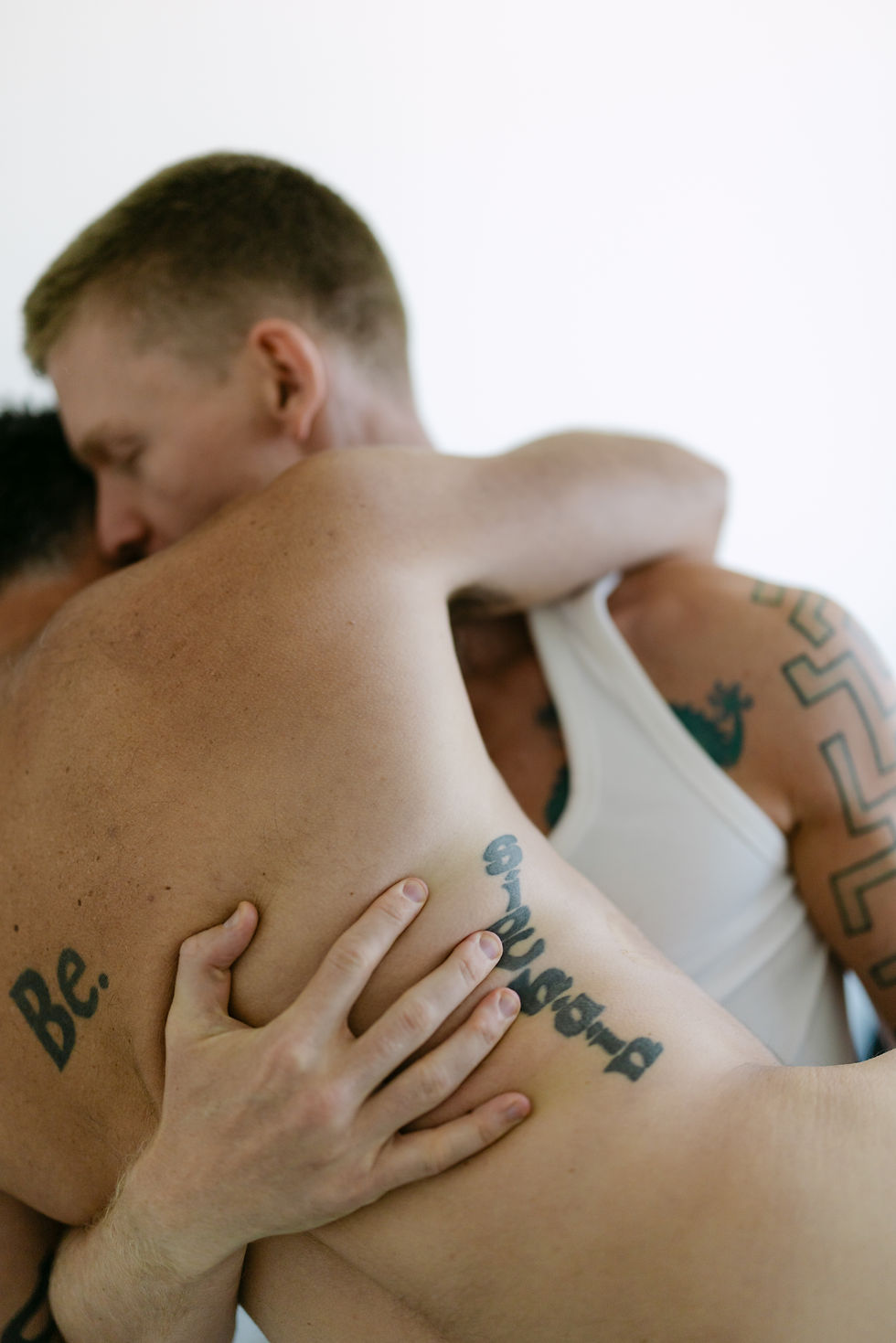
I’m a very praise-based dom.
“What a good boy,” “That’s a good girl,” “Yes, just like that,” “You’re doing such a good job,” “Beautiful breath,” “I love the noises you’re making” are very common phrases that move through me in session.
So on top of having a loving, conscious, and judgement-free space for potentially shameful desires to be met, those desires are also showered in praise, further rewriting the narrative that they are not only okay/safe, but also explicitly good.
Additionally, the sub is also given clear instructions of exactly what to do in every moment. This eliminates the effect of shame that has us questioning—especially in sexual/intimate settings—“Am I doing this right?”—the effect of shame that has many of us in a constant state of guessing and performing the behaviors that will keep us accepted and loved and not rejected by those we’re with.
This allows us a lived experience of enacting the exact “goodness” we’re constantly chasing. There’s no more guesswork. The client simply follows clear instructions.
Now let’s go even deeper into the mechanics behind the energies I work with in session, and how they relate to shame.
I believe there are different flavors of pleasure we experience. Think of the pleasure of singing to your favorite song in the car with the windows down on the highway vs. the pleasure of enjoying a delicious meal, vs. the pleasure of deep sexual arousal.
There’s a very specific current of pleasure that I access and follow in session with clients that’s in the world of sexual arousal. It’s a deeply embodied/visceral pleasure that lives and/or is generated in the Sacral Chakra (hence Sacral Steve 😉).
This current of arousal/pleasure lives deep in the body. When we start accessing it, and digging for deeper layers of it in session, it’s very common for a lot of unpleasant or heavy emotions/energies to come up along the way.
This specific flavor of arousal is a very generative and expansive energy. It is often buried beneath layers of trapped emotions and pain. When we go exploring for this pleasure and coaxing it up and out of you, everything that it’s buried underneath often needs to flush out of your system to create room for the expression and expansion of this pleasure.
This shows up as large emotional releases in session. Emotional releases (crying, grieving, raging) are also expressions of our erotic selves. And all forms of the Erotic are shackled by shame (not just sexual expressions).
So many of us have learned to suppress our emotions. Not to cry, not to be too big, “dramatic,” or emotional. Many of us have been punished and actively shamed for these very natural and healthy expressions of ourselves.
Most of us have a lot more unprocessed emotions, pain, and trauma than we’d like to admit/realize. When decades’ worth of these challenging emotions have been deemed unsafe and unworthy by the conditioning we’ve suffered along the way, these aspects of self, much like our desires, are suppressed and shoved into the unconscious. They’re cast into the shadow and join all the other parts of ourselves we deem unlovable and hide from everyone, including ourselves.
Shame is very closely linked to our sense of identity. The ego takes solace in knowing who we are—in a fixed sense of how we see ourselves and how the world around us sees us. The identity we’ve constructed is the identity we’ve found safety and acceptance in. The one that has glued together the curated image of self that is perpetually evading the shame lingering under the surface.
And for many, that curated sense of self doesn’t include the messy, expressive, loud, and turbulent version of ourselves that comes alive when all of that unprocessed emotion is vacating our system by moving through us.
That egoic identity also doesn’t want to admit or recognize the pain that’s been shoved under the rug.
What would it mean about ourselves if we actually were holding more pain than we’ve let ourselves realize? If I identify as someone who is strong, sturdy, capable, successful, and self-reliant, who would I be if I become aware of and truly recognized the abuse, neglect, and trauma I’ve suffered along the way?
To avoid these threats to our rigid sense of self, it’s incredibly common for us to live/operate from a place further and further out of our bodies and into our minds—because our bodies are the place where all of that pain resides.
Therefore, when I start taking clients deeper and deeper into their bodies via pleasure, it’s not uncommon for that stored pain to get kicked up along the way. Think of this flavor of arousal as hot, churning magma deep beneath the crust of the earth. As more and more of this potent energy is generated, it requires more space to expand into. And to find more space, it breaks through the crust of the earth (i.e., all the layers of repressed emotions we’ve locked down along the way) like a volcano erupting, expelling everything that’s blocking its path.
And when it does—when the tears start flowing—especially in the presence of someone else—it is so common for the client’s identity-protective mechanism to kick in. To start closing off and shutting down those feelings. One, because they are big and painful feelings; they don’t feel good to express and release, and two, because they become deeply exposed in the process.
They’re no longer in the perceived safety of the composed identity they’re so used to being seen in. Instead, they’re cracked wide open, both experiencing the layers of pain that have been shoved into the shadow AND being witnessed in that erotic expression of pain by another.

And this is where the Dom/Sub dynamic is an incredible tool to catalyze this release.
The protective shutting-down mechanism typically looks like trying to hide and prevent this release from happening. Closing off physically, attempting to cover their face, curl into their body, restrict breathing, and energetically constricting inward.
It’s like, as the volcano is trying to erupt, the mantle of the earth is doing everything possible to re-solidify and prevent the explosion from continuing.
The commands from me then became a clear force to counteract those instincts to prevent the eruption, paired with powerful words of praise for the continuation of the release itself.
Phrases like “Keep your arms open,” “OPEN,” “GOOD. Yes, just like that. BREATHE. Louder. You’re doing incredible. Beautiful. OPEN. STAY OPEN. Yes. You’re such a good boy. What a beautiful girl. I’m so proud of you” become vectors of energy flowing from my voice that help prevent the mantle of the earth from solidifying and closing in on itself.
All the while, the pleasurable touch/action that I continue bringing to the client acts as another vector of energy that fuels the eruption force of the magma.
It’s pleasure alchemy enriched by praise-based domination.


Comments